

It was April 2007, and I had just been barred entry from the hockey locker room.
I stood there, tape recorder in one hand, reporter’s notebook in the other, feeling confused as an assistant coach approached me, saying he’d send out players to speak with me, but they weren’t prepared to “let a woman into the locker room.”
At the time, I wasn’t so much offended as I was confused. At age 22, I’d just graduated from journalism school a few months earlier, but I’d worked for newspapers as a sports reporter throughout college, and I’d done post-game interviews in lots of locker rooms, including the Minnesota Twins.
It really wasn’t that big of deal. I was there to do a job. The players had always been professional. But now, starting out my first game as the Naples (Fla.) Daily News beat reporter for East Coach Hockey League’s Florida Everblades, I couldn’t get the interviews that made it possible for me to do my job.
A girl born more than a decade after Title IX (theoretically) granted girls and women equal access to athletic and academic opportunities, I guess I’d taken for granted in many ways my place in sports. I’d been a three-sport varsity athlete in high school, though I did quit basketball my senior year, partly so that I could attend the boys’ games, who played the same nights as the girls, though at opposite sites.
I knew that the boys’ football games would always draw a bigger crowd than our volleyball games, but there were also boys my age who made signs for us and attended faithfully. I never once thought it was weird that as a high school junior, I was the newspaper’s sports reporter. Or that as a college sophomore, I’d been chosen to report on the NCAA men’s basketball Final Four.
So in this moment at an ice arena in Southwest Florida, I experienced some of the worst of gender prejudice in sports I’d experienced thus far in life.
And in the days, months and years that followed for me as a hockey beat reporter, I’d also experience some of the best that men’s sports can be when it comes to women - and how men in sports can advocate, support, and bring equity to their female counterparts.
In the days that followed my banishment from the locker room, my newspaper editors and team personnel swung into action. My sports editor offered full support, saying they’d accept nothing less than for me to have equal and full access to the male reporters who’d always covered the team. Even though I was replacing a longtime beat reporter who was a white man in his 40s with a wife and kids, my editors were clear that 22-year-old female me deserved the same respect from the coaches and players.
And the team responded in kind. They apologized quickly for what happened that first night and said they’d had a team meeting (which is kind of amusing now) to make sure everyone was aware that there would be a woman in the locker room after games. The team’s coach at the time would set a high bar for me in his respect and accessibility. The players, too, from that time forward, were friendly and forthcoming. In a Southwest Florida dominated by retirees, we shared a few things in common: we were fellow 20-somethings from the North, in a strange and new place. In that sense, it sometimes felt like we were friends.
Given this history, maybe it’s not surprising that I’ve found myself constantly thinking about what happened for the USA men’s and women’s hockey teams in this month’s Milan Winter Olympics.
For this Minnesota native, raised on stories of Do … you … believe … in miracles? and a statewide pride that a majority of that 1980 gold medal men’s hockey team were from Minnesota, nine of them alumni from Herb Brooks’ Gophers college teams - this Winter Olympics hockey performance by Team USA should have been occasion for straightforward celebration. Both the men’s and women’s hockey teams finished undefeated, beating perennial favorite Team Canada (both in overtime) in the Gold Medal championships.
And throughout the Games, there seemed to be genuine camaraderie and mutual support between the men’s and women’s teams. Multiple men’s team players attended the women’s games, including star brothers Quinn and Jack Hughes, who scored the gamewinner in overtime in the gold medal game.
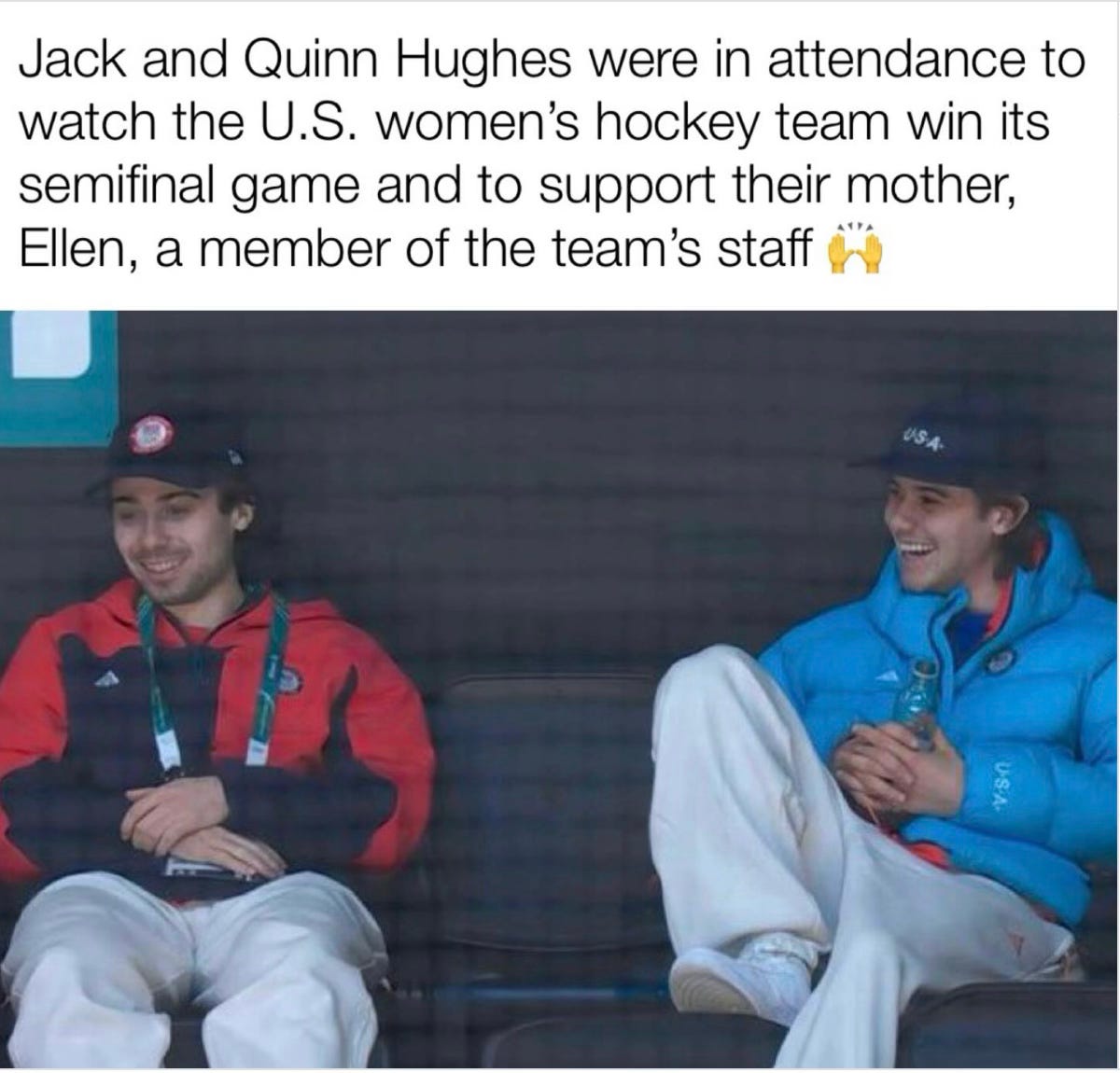
As a mom of boys who play sports (though not hockey), I loved reading about Ellen Hughes, a hockey player in her own right, who is not only Jack and Quinn’s mom but also a player development consultant to the women’s team.
The Hughes’ family seemed to represent a positive future for the sport of hockey, as this past week a year-old clip resurfaced of Jack Hughes stating his support for the NHL’s Pride Night, despite several NHL players publicly opposing the initiative at the time.
When I was a hockey reporter, I sometimes saw those tensions in action with the players I covered, both in their actions on the ice and also as I experienced them socially in our tight-knit community of Southwest Florida 20-somethings. There were definitely players who were much less respectful of women than others, and non-white players in hockey were still a distinct minority. Nevertheless, I would say that my overriding experience leaned more into the images of support by the Hughes brothers for their female athlete colleagues, and Jack’s comments in support of LGBTQ people.
In fact, I often tell people today that I experienced far less sexism within the hockey locker room than I have to date in the Church and in Christian circles, as a researcher, writer, and Lutheran pastor who writes and speaks about Christian Nationalism.
The best of how I experienced the pro hockey players I knew was that they were hard-working young men who respected that hard work and perseverance when they saw it in others, no matter who those people were. When I announced I was leaving my position as the team’s beat reporter to go to seminary in Minnesota, I’ll always remember the kind words of many of the team’s players, some of whom went on to NHL stardom. They told me they’d respected and appreciated me as a reporter, even when I’d had to deal with a hostile coach (who replaced the original coach I’d first worked under). Their words of affirmation meant the world to me as a young sports journalist who was still finding my way. My job covering the team hadn’t been easy, especially with a group of absolutely rabid fans who devoured my coverage of the team and sometimes criticized me personally. So to have a relationship of mutual respect with the athletes I covered set a bar for me for what I hoped in future colleague relationships (and friendships) with men throughout my life.
I imagine that the USA women’s hockey team has the same hopes for their relationships with the men’s team, despite ongoing disparities in pay and attention — still there has been a hopefulness in recent years for male support of women’s sports. I love seeing young basketball playing boys wearing Caitlin Clark jerseys and talking about how much they love Paige Bueckers. I love when I hear my teenage son and his friends talking about going to girls’ basketball games. This is the hope that I have for men and women forging respect and mutuality through sports - and it’s what I experienced both as an athlete and as a sports reporter.
But then the men’s hockey team Olympic postgame happened.
And I can viscerally feel that crushing feeling the women’s team must have felt when they heard about the phone call from President Trump, who told the men’s team:
“I must tell you, we’re going to have to bring the women’s team, you do know that,” he said, adding that if he did not invite the women:
“I do believe I probably would be impeached,” he said.
In video recordings of the call, you can hear the locker room (which, notably, was filled with drunk players, and, oddly, a seemingly drunk FBI director Kash Patel) erupt in laughter, though reportedly you can also hear a voice say:
“Absolutely. Two for two.”
That voice gives me hope. But Trump’s words, and the laughter accompanying them, fill me with a familiar dread. Women know what it feels like to be the butt of a joke, even a stupid joke. That laughter is worse than outright ridicule or condemnation. It’s the same laughter that greets jokes made by Evangelical preachers at their wives’ expense. The same laughter that I remember hearing from senior high school boys, who gathered around the top of the stairwell in my suburban Midwestern high school to look down girls’ shirts and evaluate our appearance.
Quickly, purposefully, the right-wing MAGA movement sought to politicize the men’s Team USA hockey victory. On social media, people I’d never before seen mention hockey (many of them people I knew in Southern states where hockey wasn’t popular) were suddenly proclaiming their pride in Team USA (the men only, notably). They draped themselves in the flag and patriotic, red, white, and blue images of eagles.
As they did so, I remembered how I felt when the video of Trump ridiculing women on a bus with Billy Bush surfaced.
Among other outrageous comments, the President who is allegedly mentioned a million times in the pedophiliac Epstein files said:
“And when you're a star they let you do it. You can do anything.”
I was 31 when I thought those comments would disqualify Trump from the presidency. I’m now almost 41, and he’s President for the second time.
At the time, Trump and his conservative Christian allies said the comments were “locker room talk,” and I thought to myself: “I have never heard comments like that in the locker rooms I frequented.”
As I’ve said, I’ve been in a lot of professional athlete locker rooms, from hockey to post-2009 Super Bowl, to MLB and NBA. And yes, some players don’t treat women well, or use their athlete status to take advantage of women or cheat on their wives and girlfriends. But as a reporter, overwhelmingly, my experience was one of respect and mutual professionalism. That’s it.
My thought then was that Trump desperately wanted the “cool factor” of being a professional athlete, but he’d never have it. The fame and power he had was mostly because he had a rich father, and then he became a reality TV star. He didn’t know what it was like to work hard for your success, to rise early every morning for 5 a.m. hockey practice, followed by dry land conditioning and endless film study. The professional male athletes I knew had all put immense time and effort into their sport. This gave them respect for anyone, of any gender, who had done the same with their sport or craft. This is what enables, I think, the possibility for mutual support and admiration among professional athletes of all genders, something that has made great positive strides in my adult life.
I wanted to think - and I still do want to think - that Trump and the MAGA movement he represents is out of step with the best of what sports can offer, including hockey, which has often been noted as the most politically conservative professional American sport (not surprising as hockey is also the whitest professional American sport).
I believe the best of the future of sports lies with the witness of Colin Kaepernick and not with the backwards-looking mockery represented by Trump and Patel, who I see as invaders in the locker room, not people who earned the right to be there.
As I write this on Tuesday, Feb. 24, the USA women’s hockey team has (rightfully) declined Trump’s invitation to the White House. Reporting earlier today indicated that the men’s team would be attending this evening’s State of the Union address by Trump’s invitation.
I would have preferred solidarity with the women. And I will be watching, alongside lots of hockey moms and dads and hockey-playing girls and women, to see how these male athletes conduct themselves. My hope is that at least some of them will speak powerfully in support of the women’s team. That they will see the stain that comes with aligning themselves with a movement that dehumanizes not only women but people of color, immigrants, poor people, LGBTQ people, and really, anyone who dares to speak against the current regime, including women journalists.
I have no doubt that if Trump would have had power over the hockey team I covered as a beat reporter in Florida, he would have mocked me as a young woman and sought to avoid giving me the respect I deserved, maybe even preventing me from accessing the locker room that he and Patel seem to think is their birthright, in process cheapening the gold medal victory and the nation it seeks to represent.
I expect that much of Trump and of MAGA in general.
But I guess I hope for more from the hockey players. I’ll be watching and listening in the hours and days ahead. Stand with your Gold Medal colleagues, not with the man who thinks a gold-plated toilet prevents him from being exposed as something America is long overdue to flush away.
P.S. …
A Few Notes:
First, a huge THANK YOU to all subscribers. I get a little email notification every time someone signs up, and every time I get one, I feel joyful and honored that you want to spend part of your day with this community. I mean it when I say: “I’m listening,” to you as well, and please don’t hesitate to share with me your thoughts + ideas for what you’d like to read in this space.
To PAID SUBSCRIBERS: I am humbled and honored that you’ve chosen to spend part of your limited budget on this newsletter. To borrow words from another newsletter I love, you are directly funding freelance journalism with your subscription, and I have to thank you more than ever for your continued support. Our world’s media and journalism is in a state of crisis, with fewer and fewer billionaires in control of global news outlets, and journalists being either laid off or threatened with violence for their work every single day; with fewer and fewer newsroom positions paying a living wage. I pledge to you to steward your paid subscription faithfully + use it to support honest, hard-working, and LOCAL journalism. One of my goals in this first year is to open this newsletter to other journalists, and pay them a fair wage for their work.
THANK YOU for your support. If you’re not a paid subscriber, please consider becoming one.
On free vs. paid-subscriber posts only: My plan right now is that the Friday + Sunday posts, focusing on news + spirituality, in that order, are available for subscribers only (I am going to continue sharing a sample, with a line where the paywall cuts off for our paid subscriber community). My plan is that the Tuesday blog-style posts will always be free, to enable as much access as possible, while creating a smaller and more intimate experience for paid subscribers, who are also able to comment and share in community in fuller ways.
Free Trial: Substack always offers a free week-long trial subscription to this newsletter, so you can get a taste of the Friday + Sunday posts and see if you’d like to subscribe!
If a paid subscription is a hardship for you, but you’d like access to the Friday + Sunday posts: PLEASE do not hesitate to reach out. I will be happy to provide a complimentary subscription for you.
Love this. I do think it is better for women athletes than it used be -- and that more of the men get it. I pass along this about my Nordic-combined, World Cup winning niece and her friends working for women to be included in the Olympics: https://happening-here.blogspot.com/2026/02/why-cant-girls-play.html
well said..you articulated my emotions, my thoughts much more eloquently than I could ever do. I am saddened by this entire situation. For those players who have daughters, I hope they can reflect, when sober, how this will impact girls and women across the globe.